Self-Driving Labs: The Closed Loop That Ends the 12-Year Drug
The thesis
The 12-year, $2-billion drug is not a law of nature — it is a symptom of a broken loop. Today a human proposes a molecule, waits weeks for a wet-lab result, reads it, and proposes the next one. The rate-limiting step is not chemistry; it is the human sitting inside the design–make–test–learn loop.
The inversion
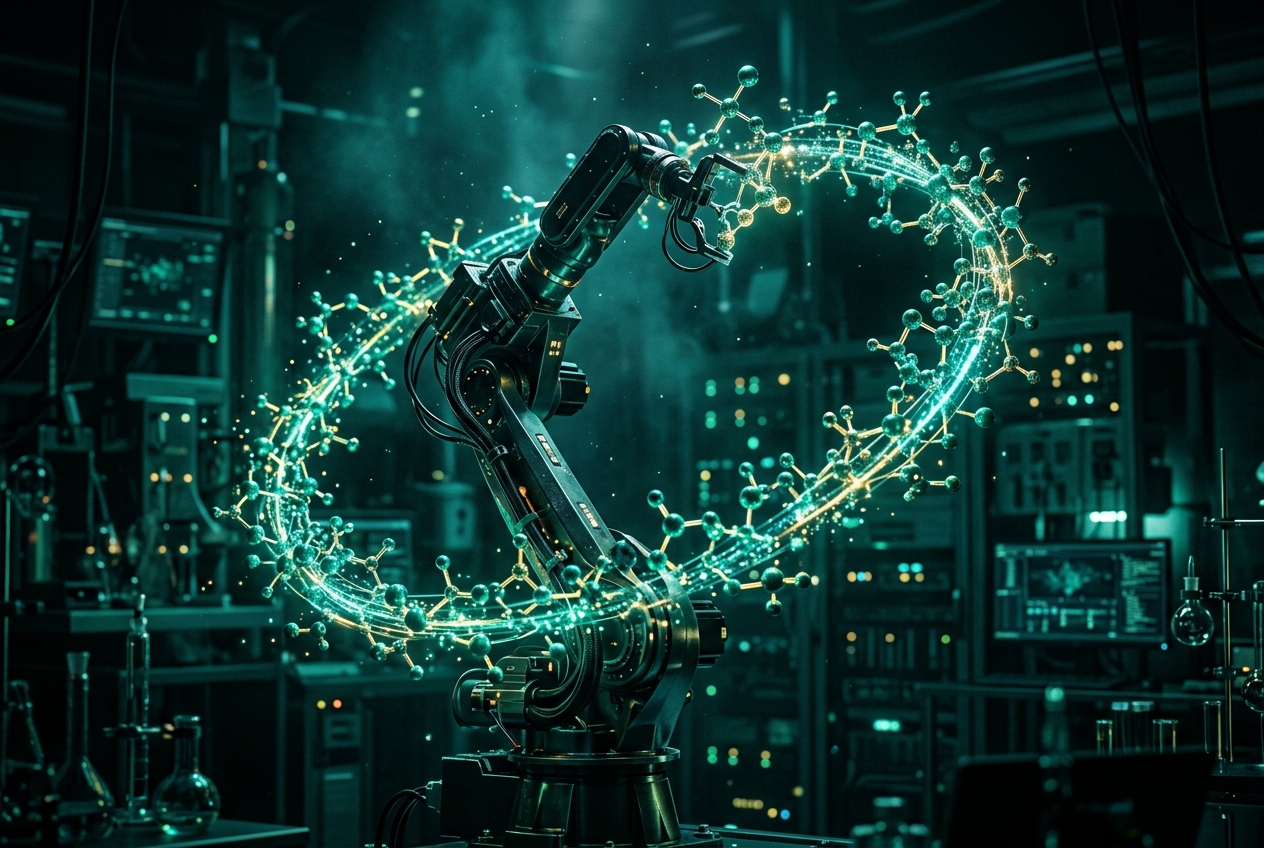
Move the scientist above the loop. A self-driving lab runs the cycle autonomously: a generative model proposes candidates, robotic synthesis makes them overnight, assays test them by morning, and a Bayesian active-learning agent chooses the next batch by lunch — thousands of experiments a week, each one chosen to maximally reduce uncertainty, not to confirm a hunch.
Why this is different
- Curiosity as an objective function. The agent is rewarded for information gain, so it deliberately runs the experiments a human would never fund because they "probably won't work" — exactly where the surprises live.
- Negative results become fuel. Every failure sharpens the model instead of vanishing into a lab notebook.
- Provenance by construction. Because a machine ran it, every step is timestamped, attributable and reproducible — 21 CFR Part 11 and ALCOA+ satisfied as a byproduct, not a chore.
What leaders should do this quarter
- Pick one target class and instrument the entire loop end-to-end — no human handoffs.
- Reward the platform for reducing uncertainty, not for hits.
- Treat your failure archive as a strategic asset and feed it back in.
The company that closes this loop first doesn't discover drugs faster. It discovers at a different rate — and rate compounds.
A first-principles provocation from the Anxya Health Futures desk. Directional and informational — not medical, legal, financial or regulatory advice. The point is to move the debate, then do the hard validation work.